

“Does X spark joy?”
Sometimes when I begin working with a client and introduce the idea of asking whether something “sparks joy,” I’m met with a bit of a blank stare. Appliances, picture hooks, and a drawer of spare buttons are rarely accused of sparking anything, so the question, valuable as it is, lands a little sideways intially.
Asking if an item “sparks joy” comes from the Japanese verb tokimeku — and its noun form, tokimeki, the flutter itself. The translation to “spark joy” falls a bit short, which is why I’ve come to realize how much the concept benefits from a proper explanation rather than a dictionary entry.
Lost in translation
Hoping for a cleaner bridge into Dutch, I once looked up the direct translation of tokimeki from Japanese into Dutch instead of going through English first. It was not an improvement. Tokimeku turns out to be one of those words that benefits from a story rather than a dictionary entry.
While I was in Japan, I asked our tour guide, a woman of my age what tokimeki meant to her. Once she understood which word I meant, she sat up a little in her chair, crossed her arms over her heart, and fluttered her hands slightly to show a bit of excitement. “It’s like the feeling you got when the boy you liked walked into a room and you saw him coming towards you.” She raised her arms into a huge “Y” and said, “It’s not this.” Then she lifted them just a little into a small “y” and smiled: “It’s this.” Tokimeki isn’t fireworks. It’s a gentle lift—a quiet feeling that says, “Yes, this belongs in my life.”
My fellow KonMari consultant, Hiroko, described it differently: “It’s what you like without thought, without thinking.” And Marie Kondo herself puts it more simply still: tokimeki is “the thing that speaks to your heart.”
Three different people, three different explanations, all pointing at the same feeling: something your body recognizes a half-second before your brain has an opinion about it. None of them mentioned a pros-and-cons list or a form of reasoning. So asking yourself if something sparks joy is asking yourself to tune into the immediate, visceral reaction you have to a belonging to help you decide what to keep and what to let go.

Why the Feeling Matters More Than the Word
Raising your awareness of what actually brings you joy in your home, or even your workspace, means listening to that same instinct: the voice of your own heart telling you what matters and what doesn’t. Decisions made this way tend to be ones you can actually live with afterward.
“You don’t miss what you didn’t love.'”
— Sheila Carroll
The Joy Test, Step by Step
The test itself is simple, even if it feels a little strange the first time. For each item, one at a time, you check in with yourself, not by looking at it, but by holding it. Standing in front of an already-sorted category, closet or drawer, and touching each piece one by one tends to do the trick.
This shifts the decision from your head to your heart and gut, which is a bigger change than it sounds. If what you feel when you hold something is a shrug, a “meh,” that’s your answer. It’s a no. Your sweater from 2009 is under no obligation to still represent who you are. Once you’ve set aside everything that didn’t spark something, what’s left has actually earned its place in your home, as your life is now, not as it was when you first acquired it.
Choosing What Stays, Not What Goes
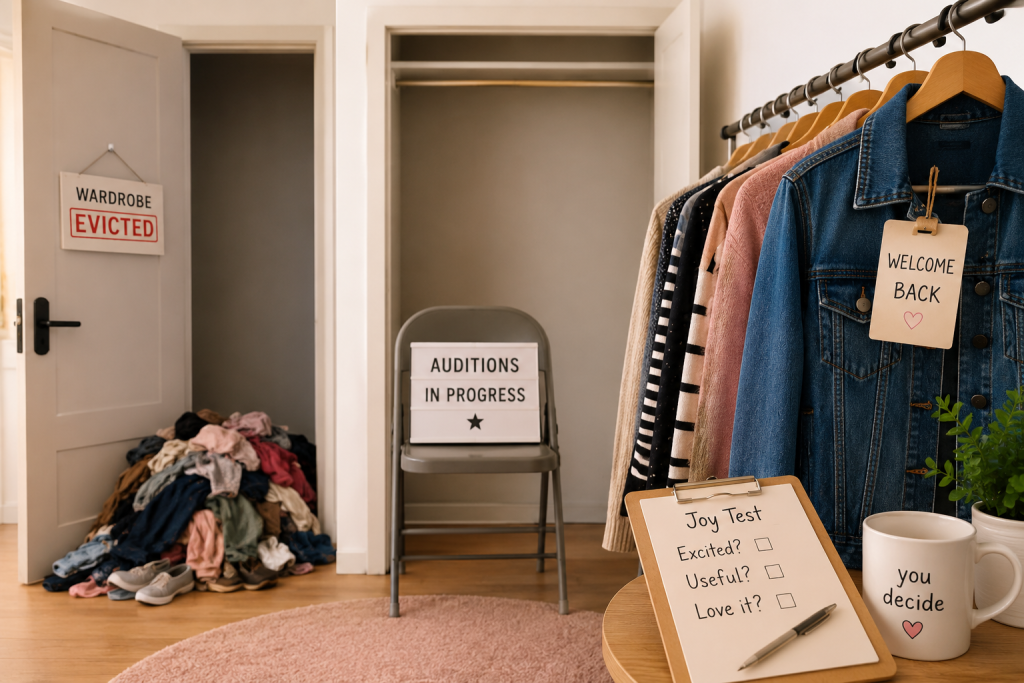
One small mental trick that helps: stop thinking of this as deciding what to discard, and think of it instead as choosing what to bring back in. Imagine, just for a moment, that everything has already left the house, and you’re the one deciding what gets to return. It’s a full reversal. You’re no longer letting go of things. You’re choosing what stays.
It’s an unusual little exercise, mentally evicting your entire wardrobe and then inviting pieces back one at a time like you’re hosting auditions, but it works.
A good way to begin: before starting the test properly, pick your three all-time favorite pieces of clothing. Pull them out, set them where you can see them. These become your benchmark, your own personal definition of what sparking joy actually feels like, so you have something to measure everything else against.
Some items won’t give you a clear answer right away. That’s fine. Flag them, set them aside, and come back at the very end. It’s almost always easier to decide on the uncertain pile once everything around it has already been sorted, the contrast does some of the deciding for you.
Letting Go With a Thank You

One last piece worth holding onto: some things sparked joy once and simply don’t anymore, and that’s not a failure of the item or of you, it’s just time passing. A small, conscious “thank you” to the object on its way out can soften that moment, sometimes even bring a smile, and it tends to make the letting go noticeably easier.
I’m a Head Person Too
I’ll admit, the first time I guided a client through a joy test, I didn’t quite feel like myself doing it. I’m a fairly head-ruled person myself, more spreadsheet than sentiment most days. But after hundreds of hours helping people sort through their belongings, I’ve watched this approach work, reliably, in a way that “just decide logically” never quite manages to. Some decisions are simply better made by the hand and the heart than the head, even for those of us who’d rather they weren’t.
If your head and your gut disagree more often than you’d like, that’s exactly the kind of moment where a second, less personally invested pair of hands can help keep you from getting stuck. Whether in person around Amsterdam or via video call, I’d be glad to help.
I’m Sheila, your opruimcoach/professional organizer. Each month I’ll drop fresh organizing inspiration, smart tips, and a nudge to let go of what doesn’t serve you. Sign up now and get organizing inspiration without adding to your clutter pile!