
Letting go on your own terms
There’s a version of decluttering that happens after someone has passed away, when grieving children sort through decades of belongings, trying to guess what mattered and what didn’t. That’s a real and difficult process — and a different one from what this post is about.
This is about the version that happens while you’re still here to do the choosing yourself. Not because a move, illness, or other life change is forcing the issue. Because deciding now, on your own terms, is one of the more generous things you can do — for the people who might otherwise have to guess later, and for yourself, today.
The Swedes have a word for this: döstädning — literally “death cleaning.” In The Gentle Art of Swedish Death Cleaning, author Margareta Magnusson explored this thoughtful process of sorting and disposing of personal belongings in preparation for life’s final chapter. The name sounds heavier than the practice. Rather than something morbid, Magnusson framed it as an act of profound love — for oneself and for one’s survivors.
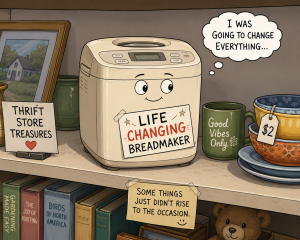
Many of us are living with a mixture of belongings accumulated over a lifetime: things we bought, things we were given, and things we inherited from parents or other family members. Some still have meaning and a purpose in our lives. Others are hanging on because nobody has taken a fresh look in years — whether that’s a set of inherited china that’s been moved from house to house, or the bread maker that was definitely going to change your life back in 2007. Decluttering gives you the opportunity to decide what truly belongs in your life now, rather than continuing to live with yesterday’s decisions.
Why We Keep Things That No Longer Spark Joy
Most items that linger in our homes long after we’ve stopped using or enjoying them tend to fall into one of four categories. Naming them can make them easier to let go.
Gift guilt. Someone gave you something, so letting it go feels like rejecting the person. But the relationship was never stored in the object. The gift has already done its job.
Money already spent. Economists call this the sunk cost fallacy: we keep things because we paid for them, as though holding onto an unused item somehow earns the money back. It doesn’t. The money is gone either way. The only live question is whether the item is earning its shelf space now. Sadly, closets have never been known to issue refunds.
A memory tied to a thing. We sometimes worry that letting go of an object means letting go of the memory attached to it. But memories don’t live in things — they live in us.
I learned that firsthand when I recently shrank a sweater my late husband had given me until it would have fit a toddler. The sweater is gone, but the memory of his delight in giving it to me remained exactly as it always has. To be honest, though, I’m holding a grudge against the washing machine.
“Just in case.” Sometimes it’s wise to be prepared (e.g. fire extinguisher or first aid kit). More often “just in case” is simply decision avoidance (e.g. that single rollerblade).
When you say “just in case,” can you actually finish the sentence?
“Just in case _____ happens.”
Then ask yourself: How likely is that? And if it did happen, is keeping this item really the best solution?
How the KonMari Order Helps
The KonMari method moves through categories in a specific sequence: clothes, then books, then papers, then miscellaneous items, and sentimental objects last. That order isn’t arbitrary. Deciding what to keep is a skill, and like any skill, it sharpens with practice. By the time you reach the photographs, the letters, the items that carry the most weight, you’ve had dozens of smaller, lower-stakes decisions to build your judgment. You arrive at the hardest category with a clearer head than if you’d started there.
For anyone downsizing later in life, that sequencing matters even more. The sentimental items are exactly the ones you want to handle when you’re not exhausted, not rushed, and not doing it for the first time that day.
The Practical Case for Doing This Now
There are practical reasons to declutter as well.
A clear floor is a steadier one, decluttering is one of the simplest, most fixable ways to cut fall risk at home. And a lighter home is also a safer one if there’s ever a fire: less to catch, and a clearer way out.
Magnusson also suggests beginning this process around age 65 — or sooner — so your home is safer to live in and you still have the energy the work requires. There’s no urgency in that number, just a practical acknowledgment that doing it while it feels manageable is easier than doing it when it doesn’t.
That doesn’t mean anyone needs to live in a minimalist show home with three possessions and a single decorative pebble.
The goal isn’t less for the sake of less. The goal is enough space to move easily, find what you need, enjoy what you own, and feel at home in your home.
A note on past hobbies, projects, and the things we meant to do

How about the things we tiptoe past, a category that almost everyone has: things connected to a hobby you drifted away from, a project you never finished, a version of yourself you were planning to become. The sewing machine. The golf clubs. The exercise bike you have to dust.
Then there’s the binder or binders. The course material you were going to review — the photography workshop, the nutrition programme, the language class — sitting on a shelf with the best of intentions. The purpose of those notes was to help you learn. If you absorbed what mattered, the learning lives in you now, not in the pages.
When you come upon these items here’s something worth remembering: you bought that thing at a point in your life when it made sense. Time passed, priorities shifted, energy changed. That’s not failure — that’s just a long life. The purchase was not a mistake; the situation simply moved on without it.
And if the object itself is still good. It’s not a monument to an abandoned intention. It’s a useful thing waiting for the right owner — someone who will actually use it, which is exactly what you originally wanted. Letting it go isn’t the shame. Keeping it, so that it can remind you of that story every time you walk past, might be.
Sometimes the objects belong to someone who is no longer here — a family member’s sheet music, a parent’s woodworking tools. These sit at the intersection of decluttering and grief. One useful question: is there a single piece that holds the essence of who that person was? Keep that, and consider letting the rest go somewhere it will be used — a music school, a community group, a maker space. Watching someone else carry forward a passion your person loved is not a small consolation.
A Four-Part Action Plan
Beyond sorting and letting go, döstädning suggests a few concrete practices that can make this process more intentional — and more enjoyable.
1. Give things away while you’re alive to enjoy it.
Magnusson advocates for passing on possessions while you’re still alive — so the giving is actually giving, not just leaving. Passing something on to someone who actually wants it adds a layer of life to the whole process. You get to see your grandmother’s soup tureen go to someone who will use it. You get to tell the story behind it. There’s great joy in that.
If something still brings you genuine pleasure, that’s reason enough to keep it. But when the joy has passed — when you’re holding something you’ve finished with rather than something you love — that’s when Magnusson’s question becomes useful: “Will anyone I know be happier if I save this?” The power of that question is that it opens up honest conversations within families about the few things that truly matter — and makes letting everything else go feel almost easy. If someone comes to mind when you ask that question, even better — give it to them now, and enjoy the giving.
Younger relatives might appreciate the chance to “shop” for things they need for a first home or apartment. These conversations, while they can feel awkward to initiate, tend to bring families closer rather than the reverse.
2. Accept gracefully when no one wants what you want to pass on.
You can ask. You can offer. But if the answer is no, that’s information, not a verdict on the value of your life or your taste. Some things are ours alone to have loved, and that’s enough. The item can go to someone who will actually use it — or simply go — without diminishing what it meant to you.
3. Start with the easy categories.
Magnusson suggests beginning with possessions that are straightforward to release — unworn clothes, unwanted gifts, duplicate items, more plates than you’d ever actually use — while keeping a lighter touch on photographs, love letters, and things with genuine personal history. The easy categories build momentum and sharpen your judgment for the harder ones. This is exactly how the KonMari method works too — both approaches trust that the skill of letting go improves with practice.
4. Write down your wishes for the things that matter.
Some items will need more than a label. For furniture, artwork, jewellery, or objects with family history, a simple written note — kept somewhere findable — explaining what an item is, where it came from, and who you’d like to have it, is a profound act of care. It removes guesswork and keeps conflict out of grief.
You Don’t Have to Do This Alone
One reason decluttering can feel difficult is that every object comes with history.
A professional organizer brings something surprisingly useful: neutrality.
I don’t have memories attached to your mother’s teacup, your collection of ceramic owls, or the box that’s been sitting in the attic since 1994. I’m not emotionally invested in whether an item stays or goes, and I’m not part of the family dynamics that can make these decisions complicated.
That distance creates space for you to notice your own reaction. Often, people already know how they feel about an item. They simply need an environment free from pressure, guilt, expectations, and well-meaning opinions.
Friends and family usually bring history. I bring neutrality.
And occasionally a very good question.
If the idea of starting feels heavier than the boxes themselves, that’s normal and it’s exactly the kind of thing a second pair of hands and a clear process can make lighter. Whether in person around Amsterdam or via video call, I’d be glad to help you get started, one category at a time.
Further reading: Margareta Magnusson, The Gentle Art of Swedish Death Cleaning (2017)
I’m Sheila, your opruimcoach/professional organizer. Each month I’ll drop fresh organizing inspiration, smart tips, and a nudge to let go of what doesn’t serve you. Sign up now and get organizing inspiration without adding to your clutter pile!